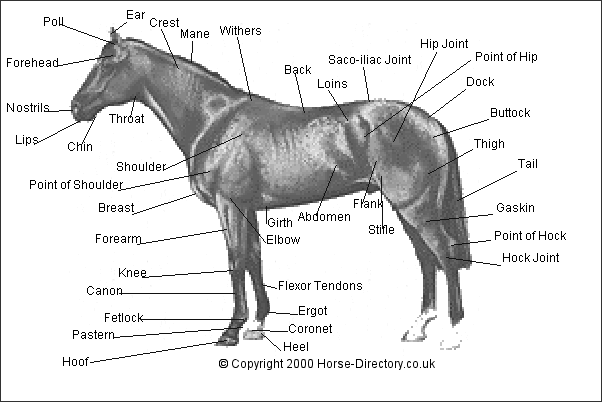
back: the area
where the saddle goes, begins at the end of the withers, extends to the last thoracic vertebrae.
(Colloquially includes the loin or "coupling," though technically
incorrect usage)
barrel: the main body area of the horse, enclosing
the rib cage and the major internal organs.
cannon or
cannon bone:
The area between the knee or hock and the fetlock joint, sometimes
called the "shin" of the horse, though technically it is the metacarpal
III.
chin groove: the part
of the horse's head behind the lower lip and chin. (the area that dips
down slightly on the lower jaw). Area where the curb chain of certain bits is fastened.
coupling: see "Loin" below.
coronet or coronary
band: The ring of soft
tissue just above the horny hoof that blends into the skin of the leg.
crest: the upper portion of the neck where the
mane grows.
croup: the
topline of the horse's hindquarters, beginning at the hip, extending
proximate to the sacral
vertebrae and
stopping at the dock of the tail (where the coccygeal
vertebrae
begin). Sometimes called "rump."
dock: the point where the tail connects to the
rear of the horse.
elbow: The joint
of the front leg at the point where the belly of the horse meets the
leg. Homologous to the elbow in humans.
fetlock: Sometimes
called the "ankle" of the horse, though it is not the same
skeletal structure as an ankle in humans. Known to anatomists as the
metacarpophalangeal (front) or metatarsophalangeal (hind) joint;
homologous to the "ball" of the foot or the metacarpophalangeal joints
of the fingers in humans.
flank: Where the hind legs and the barrel of the
horse meet, specifically the area right behind the rib cage and in
front of the stifle joint.
forearm: the area
of the front leg between the knee and elbow. Consists of the fused radius and ulna, and all the tissue around these bones.
Anatomically the antebrachium.
forelock: the continuation of the mane, which hangs
from between the ears down onto the forehead of the horse.
frog: the
highly elastic wedge-shaped mass on the underside of the hoof, which normally makes contact with the
ground every stride, supports both the locomotion and circulation of
the horse.
gaskin: the large muscle on the hind leg, just
above the hock, below the stifle. Homologous to the calf of a human.
girth' orheartgirth: the area right behind the elbow of the
horse, where the girth of the saddle would go, this area should be
where the barrel is at its greatest diameter in a properly-conditioned
horse that is not pregnant or obese.
hindquarters: the large, muscular area of the hind legs,
above the stifle and behind the barrel of the horse.
hock: The tarsus of the horse (hindlimb equivalent to the
human ankle and heel), the large joint on the hind leg.
hoof: The foot of the horse. The hoof wall is the
tough outside covering of the hoof that comes into contact with the
ground. The hoof wall is, in many respects, a much larger and stronger
version of the human fingernail.
jugular groove: the line
of indentation on the lower portion of the neck, can be seen from
either side, just above the windpipe. Beneath this area run the jugular vein, the carotid
artery and
part of the sympathetic trunk.
Kentucky Derby: Horse
race held annually in Louisville, Kentucky in 1st week of May. It's the
1st leg of Triple Crown race and known to be the biggest horse race in
North America. If you are looking bet online on Kentucky Derby day,
then take a look at this site before you bet
knee: the carpus of the horse (equivalent to the human
wrist), the large joint in the front legs, above the cannon bone
loin: the area
right behind the saddle, going from the last rib of the horse to the
croup. Anatomically approximate to the lumbar spine.
mane: long and relatively coarse hair growing
from the dorsal ridge of the neck, lying on either the left or right
side of the neck).
muzzle: the chin, mouth, and nostrils of the
horse's face.
pastern: The connection between the coronet and the
fetlock. Made up of the middle and proximal phalanx.
poll: commonly
refers to the poll joint at the beginning of the horse's neck,
immediately behind the ears, a slight depression at the joint where the
atlas (C1) meets the occipital crest. Anatomically, the occipital crest itself is
the "poll."
splints: bones
found on each of the legs, on either side of the cannon bone (8 total).
Partially vestigial, these bones support the corresponding
carpal bones in the forelimb, and the corresponding tarsal bones in the
hindlimb.[1]
Anatomically referred to as Metacarpal/Metatarsal II (on the medial
aspect
(inside)) and IV (on the lateral
aspect
(outside)).
shoulder: made up
of the scapula and associated muscles. Runs from the
withers to the point of shoulder (the joint at the front of the chest,
i.e. the glenoid). The angle of the shoulder has a great
affect on the horse's movement and jumping ability, and is an important
aspect of equine conformation.
stifle: Corresponds to the knee of a human,
consists of the articulation between femur and tibia, as well as the
articulation between patella and femur.
tail: consists of both the living part of the
tail (which consists of the coccygeal vertebrae, muscules, and
ligaments), as well as the long hairs which grow from the living part
throatlatch: The point at which the windpipe meets the
head at the underside of the jaw.
withers: the
highest point of the thoracic vertebrae, the point just above the tops
of the shoulder blades. Seen best with horse standing square and head
slightly lowered. The height of the horse is measured at the withers in
"hands."
 Horse
Directory
Everything For
Horses And Horse
Riding
Horse
Directory
Everything For
Horses And Horse
Riding